
An ornamental rock may appear to be nothing more than an ordinary rock to those unfamiliar with its value. Yet to discerning collectors and enthusiasts, it is regarded as a precious treasure that embodies history, artistic beauty, and the wonders of nature.
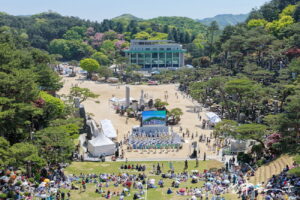
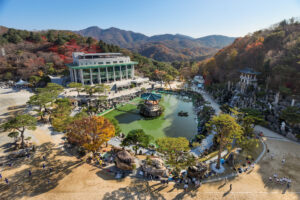
At the 2026 World’s Greatest Rock Festival, held at the Wolmyeongdong Natural Temple last May, hundreds of ornamental rocks distinguished by their unique forms and natural beauty captivated visitors.
Among the exhibits, two masterpieces drew particular attention: Guyeongugok (Nine Ponds and Nine Valleys) and Cheonjiam (Heaven-and-Earth Rock). Widely recognized as ornamental rock masterpieces among collectors, how did these two remarkable works come to be displayed at the Wolmyeongdong Natural Temple?
To learn the story behind their arrival, we spoke with Pastor Jeong Cheon-su, who served as the bridge in bringing the two ornamental rocks to the Wolmyeongdong Natural Temple.
Garden Ornamental Rock
A garden ornamental rock is a type of ornamental rock, classified alongside landscape rocks, pattern rocks, and figurative rocks. Unlike indoor ornamental rocks, which are small enough to be held by hand, garden ornamental rocks can reach several meters in size and serve as focal points in outdoor landscape design. Because they are difficult to locate in nature and transport, they are regarded as especially valuable among ornamental rock collectors.
The artistic value of a garden ornamental rock is evaluated based on factors such as water polishing, form, and overall balance. In particular, great importance is placed on whether the rock bears the marks of having been shaped over long periods by the force of flowing water and whether it displays a distinctive and mysterious form created by nature.

Treasures Among Ornamental Rock Enthusiasts: Their Journey to the Wolmyeongdong Natural Temple
Guyeongugok and Cheonjiam are garden ornamental rocks discovered in the Namhan River in June 1977, before construction of the Chungju Dam began. At the time, rock hunters spent nearly two years searching for ornamental rocks from the upper reaches of the Namhan River to its lower reaches. Even after the two rocks were discovered, it took five people working over the course of four months before they could finally be brought into the world.
According to those familiar with the story, the operation took place when the river level was low. Workers first floated 120 oil drums to create a square floating platform and attached two large pulleys. When the water level later rose, they manually operated the pulleys to lift the ornamental rocks from the river. The extraordinary effort required to retrieve them is one reason these rocks are regarded as such rare masterpieces.
Among the two, Guyeongugok is known as one of the most treasured pieces in the collection of the late Dr. Han Gi-taek, founder of Seokchowon, Korea’s first private ornamental rock museum. Revered among enthusiasts as a “jeonraeseok” (a legendary ornamental rock passed down through generations), it became so famous that visitors once chartered tour buses simply to see it, making it one of Korea’s most celebrated garden ornamental rocks.

Pastor Jeong Cheon-su said, “Guyeongugok is considered one of the finest garden ornamental rocks. It is like a gift from God, given on the first day of my three-day fasting prayer and my 70-day commitment to prayer in 2024.”
He continued, “The owner of Guyeongugok regained his health through Pastor Jeong Myeong Seok’s prayers and encouragement and was deeply moved. As a result, despite the rock’s exceptional value and rarity, we were able to bring it to the Wolmyeongdong Natural Temple under highly unusual terms.”
Originally known as “88-seon,” Guyeongugok is now named after its appearance. Its form evokes nine valleys and nine ponds, revealing a variety of natural landscapes from different angles.
It features a cavity large enough for an adult’s arm to fit inside, giving the impression of an entire natural landscape captured in a single rock. Classified as a landscape rock, the piece weighs 18 tons and is composed of Sangsudo Choco-seok(chocolate-colored stone).

Cheonjiam (Heaven-and-Earth Rock), quarried near the site where Guyeongugok was discovered, is another masterpiece that deserves special recognition. At its center is a large basin capable of holding about 35 liters of water, while its left side reveals a formation reminiscent of a range of mountain peaks.
Cheonjiam derives its name from its resemblance to Cheonji, the crater lake atop Mount Baekdu. The entire rock is covered with the distinctive natural ridges characteristic of Namhan River Choco stone, a feature that has earned the admiration of ornamental rock enthusiasts. To allow visitors to appreciate the work in its entirety—including its reverse side—it has been displayed so that it can be viewed from all angles. More recently, aerial photographs revealed that the central water-filled basin forms the shape of a heart. In addition, the center of the rock features a formation resembling a royal throne, inspiring a sense of awe in those who see it.
Pastor Jeong Cheon-su said, “The original owner of Cheonjiam was also deeply moved after visiting the Wolmyeongdong Natural Temple. While introducing Pastor Jeong Myeong Seok, we discovered that they had both served in the Baekma (White Horse) Division. Through that connection, Cheonjiam also came to the Wolmyeongdong Natural Temple under exceptional terms.”
He added, “We can confidently tell anyone that the Wolmyeongdong Natural Temple is home to some of the finest garden ornamental rocks.”
A Message of Faith Reflected in Ornamental Rocks
An ornamental rock is regarded not simply as a rock but as a work of nature embodying history, philosophy, and artistry. For that reason, it cannot easily be defined in just a few words. To be recognized as an ornamental rock, it must possess a distinct natural form, a hard and durable composition, and rich, vivid coloration. It must also reflect the beauty of nature and bear the marks of time—qualities collectively known in the ornamental rock community as the “Five Aesthetic Qualities of Ornamental Rocks.”
Guyeongugok and Cheonjiam have long been recognized as outstanding examples of garden ornamental rocks that embody all five of these aesthetic qualities. In particular, their distinctive natural forms and profound beauty, shaped by nature itself, have captivated admirers for many years.
Pastor Jeong Cheon-su said, “The rock itself is important, but so is the way it is displayed. Depending on how it is presented, different forms and aspects of its beauty can be appreciated. The Wolmyeongdong Natural Temple, which preserves the beauty of nature, is the ideal setting where Guyeongugok and Cheonjiam can be appreciated at their very best.”
Now that the time has come for these ornamental rocks to find their place at the Wolmyeongdong Natural Temple, they are conveying a variety of spiritual insights to visitors. Formed over countless years as they were shaped and refined by nature into complete works of art, these ornamental rocks symbolize the journey of believers who have endured trials and hardships while engraving God’s will and stories into their lives. In this way, they also reflect the spiritual identity the Christian Gospel Mission seeks to uphold, giving them even deeper significance.