
Since the beginning of history, humanity has dreamed of an ideal world—a utopia. The longing for a perfect society that cannot easily be achieved in reality, and the efforts to realize it, have continued throughout every age and civilization. From Buddhism’s Pure Land Paradise and Confucianism’s Great Harmony Society to the ideal states envisioned by Plato and other Western philosophers, all reflect the same human aspiration.
Such visions have served as a powerful driving force behind human civilization and have repeatedly appeared across generations as a universal desire shared by mankind.
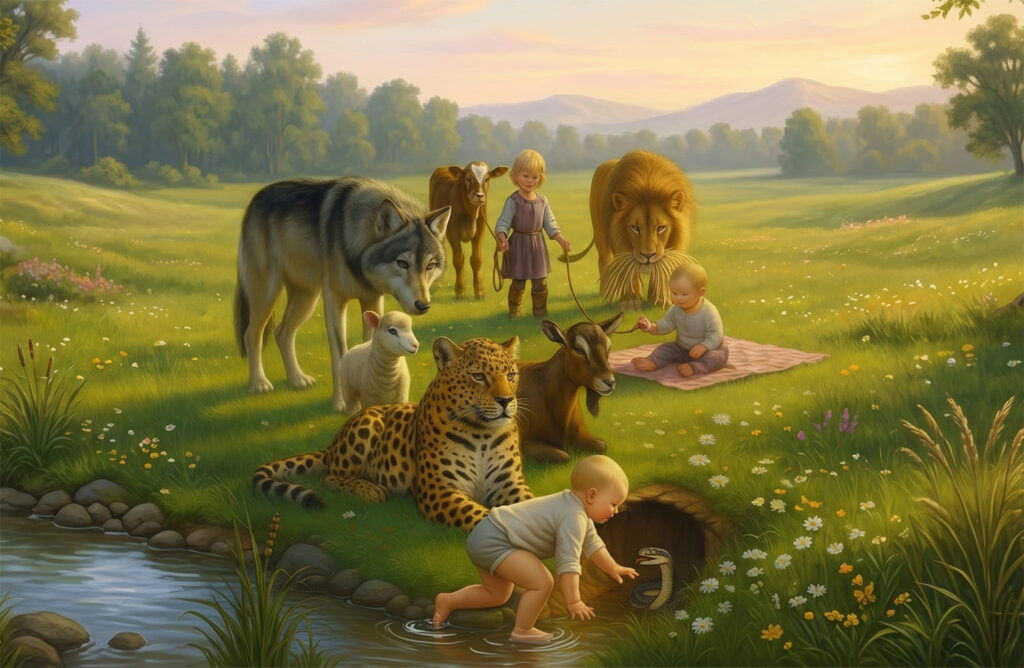
Isaiah 11:6–8 in the Old Testament is one of the Bible’s most representative passages symbolically portraying the world of peace and harmony that will arrive in the Messianic age. Various denominations interpret this passage either literally or figuratively.
The Vision of Humanity’s Ideal World in the Book of Isaiah
The Book of Isaiah vividly contains humanity’s long-awaited vision of an ideal world. Isaiah is one of the most widely known books in both the Old and New Testaments, famous for its prophecies concerning the Messiah and foreshadowing Jesus Christ’s crucifixion.
Among its passages, Isaiah 11:6–8 especially stands out as a symbolic depiction of peace and harmony in the Messianic age.
Isaiah 11:6–8
“The wolf shall dwell with the lamb,
and the leopard shall lie down with the young goat,
and the calf and the young lion and the fattened calf together;
and a little child shall lead them…
The nursing child shall play over the hole of the cobra,
and the weaned child shall put his hand on the adder’s den.”
For centuries, this passage has been interpreted in various ways within Judaism, Christianity, and many modern denominations. Debate continues regarding when and how this prophecy will be fulfilled, and whether it describes a literal world where the food chain disappears or a symbolic message expressed through metaphor.
Differences Between Jewish and Christian Perspectives: “Has the Prophecy Been Fulfilled?”
The ideal world envisioned in Judaism resembles the Garden of Eden described in Genesis. It is a state where humans and animals alike live in peace and harmony through a vegetarian order of life, which Judaism believes will be restored in the Messianic age.
The renowned Jewish commentator Maimonides interpreted this passage symbolically, viewing the animals as metaphors for the strong and the weak. In contrast, Nachmanides took a literal interpretation, believing that even the nature of animals themselves would change.
What is important is that Judaism still believes the Messianic age has not yet begun, and Jewish people continue to pray earnestly for the coming of the Messiah at the Western Wall in Jerusalem.
On the other hand, Christianity believes that this prophecy began to be spiritually fulfilled through the incarnation and ministry of Jesus Christ 2,000 years ago.
Within Christianity, interpretations are also divided into two major perspectives. Those who favor a literal interpretation believe that after Christ’s Second Coming, complete physical peace will arrive, even eliminating predatory behavior in the animal kingdom. Others interpret the passage figuratively, understanding it as the unity of former enemies becoming one community through the Gospel (Ephesians 2:14–16). According to this view, the prophecy was partially realized through the early Christian church community and will ultimately be completed when the Messiah returns.
In the 20th century, many domestic and international denominations emerged, each interpreting the Bible according to their own doctrinal perspectives.
One denomination based overseas interprets Isaiah 11 literally as an “animal paradise.” They believe that when God’s Kingdom comes, a literal earthly paradise will appear where predators eat grass and children safely play with snakes. Images depicting this vision are actively used in their evangelism.
Christian Gospel Mission’s Interpretation: The Substantial Meaning Behind the “Ideal World”
Our church, Christian Gospel Mission, interprets the scenery described in Isaiah 11 as “a perfect metaphor for the ideal world.” This interpretation is explained more concretely and systematically through the church’s core doctrine known as the “30 Lessons.”
According to the 30 Lessons, the wolf, lamb, leopard, lion, and other animals mentioned in the passage are not literal animals, but symbolize people with different personalities, backgrounds, and characteristics.
In other words, the image of predators and prey living together signifies that people of different religions, cultures, and temperaments become united through the words of the Messiah to form a community of love and peace.
According to the teachings of the Christian Gospel Mission, the wolf, lamb, leopard, calf, and lion in Isaiah 11 represent people with different personalities and backgrounds. When the Messiah comes, people from different religions, cultures, and characters become one in a community of love and peace.
Pastor Jung Myeong-seok explained that this interpretation is supported by the biblical example in Genesis 49, where Jacob blessed his twelve sons using animal symbolism. Likewise, Isaiah’s prophecy points to an ideal world in which the twelve tribes of Israel—groups with different characteristics—become united around Jesus.
The early church community formed through the unity of Jesus’ followers centered around His twelve disciples is also interpreted as a spiritual fulfillment of this prophecy.
Characteristics of the “Kingdom of Heaven on Earth”
According to the teachings of the church, the “Kingdom of Heaven on Earth” has the following characteristics:
1. Practical Transformation of Life
While the soul enters the heavenly kingdom after death, the physical body continues living on earth until the end of its lifespan, fulfilling God’s will and living as a “spiritual bride.”
2. Fulfillment of the Three Great Blessings
As stated in Genesis 1:28, this means:
- Loving God above all things,
- Growing spiritually and physically,
- Forming families at the proper time as part of physical multiplication,
- Bearing spiritual children by loving the Trinity and spreading the Gospel,
- And restoring humanity’s authority over creation.
3. Progressive Development
The ideal world is not established instantly but unfolds progressively according to God’s appointed time. According to the church’s teaching, we are now living in the era in which Jesus has spiritually returned and is fulfilling the prophesied “thousand-year ideal world” through His word.